Synchronous and asynchronous execution have a close relationship with parallelism and concurrency, two important concepts in computing that describe how multiple tasks can be handled. While they all deal with managing tasks, each term focuses on a different aspect of task execution. Let’s break down how synchronous, asynchronous, parallel, and concurrent execution are related.
Table of Contents
Introduction
- Synchronous: One task at a time, blocking.
- Asynchronous: Tasks run without waiting for each other, non-blocking.
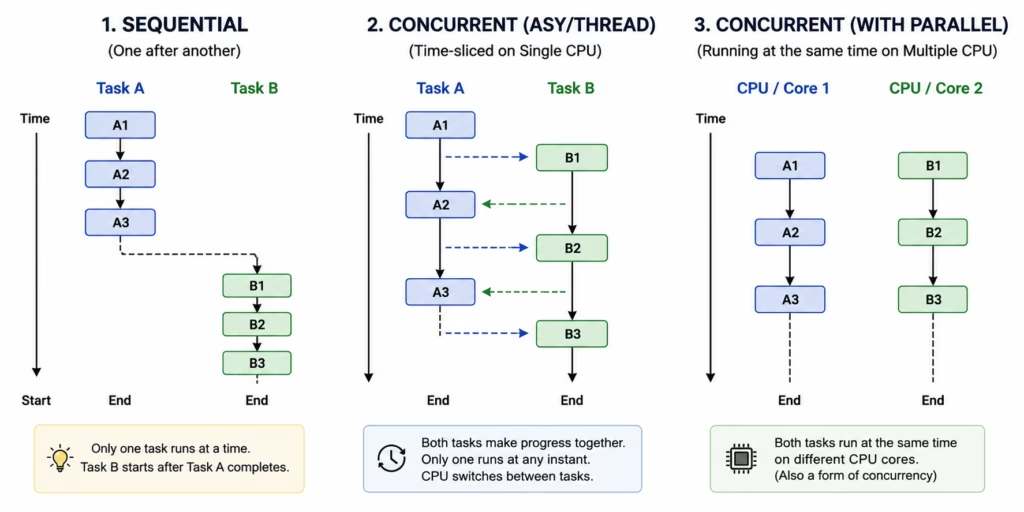
- Concurrency: where multiple tasks execute within the same time window. Doesn’t matter if they take turns or run together — as long as more than one is “in progress” during that window, it’s concurrent.
- Parallelism: where multiple tasks are actually executing at the same instant. Requires more than one physical worker (core/CPU) to be true.
Synchronous and asynchronous are about how the program handles the waiting period.
While sequential, concurrency and parallelism are about execution.
Read Synchronous vs Asynchronous
Handling Waiting:
- Synchronous: Blocks execution until the current task is complete, which can lead to inefficiencies during wait times.
- Asynchronous: Allows execution to continue without waiting, freeing up resources for other tasks.
Synchronous

Asynchronous

Execution:
- Sequential: One task at a time.
- Concurrency: where multiple tasks execute within the same time window. Doesn’t matter if they take turns or run together — as long as more than one is “in progress” during that window, it’s concurrent.
- Parallel: where multiple tasks are actually executing at the same instant.
- Time-sliced: Switching execution of multiple tasks at a very fast pace
- Asyncio(event loop): Switching is decided in code via await
- Thread: Os deciding the switching of tasks
Synchronous + Concurrency
At first glance, synchronous and concurrent execution at the same time seem incompatible, as in a single-core system, if the processor synchronously executes task 1, it cannot pick up another task until task 1 is completed.
Synchronous Concurrency occurs when a system manages multiple tasks with overlapping lifecycles, but the code inside each individual task executes synchronously (blocking line-by-line).
Instead of tasks voluntarily yielding control (like in async/await), the Operating System Kernel forcibly interrupts and context-switches between these synchronous threads or processes.
The code is synchronous, but the OS forces concurrency.
What Is Actually Happening Under the Hood?
When you write traditional multi-threaded code (like using threading in Python, C++, or Java):
- The Code’s Perspective (Synchronous): Your code doesn’t know or care about other threads. It runs line 1, blocks on line 2 (waiting for disk/network), and moves to line 3. It relies on standard, blocking, sequential logic.
- The CPU’s Perspective (Sequential): A single CPU core can only execute one machine instruction at a time.
- The OS Kernel’s Perspective (Forced Switching): The OS runs a timer interrupt (every few milliseconds). When the timer ticks, the OS kernel forcibly pauses your running thread, saves its exact memory state (registers and stack pointer), and loads another thread onto the CPU core.
Example:
- A single-core computer runs a simple application that manages two synchronous tasks, T1 and T2. The operating system (OS) creates one thread for each task.
- Although both tasks are synchronous and must be completed in order, the OS employs context switching to manage their execution. This allows the OS to alternate between T1 and T2, giving the illusion of parallel execution.
- While this approach enhances responsiveness, it also introduces some overhead due to the time spent saving and restoring thread states.
Code Example
import threading

def task1():
    print("Task 1 is starting...")
    time.sleep(2)  # Simulating work
    print("Task 1 is complete.")

def task2():
    print("Task 2 is starting...")
    time.sleep(1)  # Simulating work
    print("Task 2 is complete.")

# Creating threads
thread1 = threading.Thread(target=task1)
thread2 = threading.Thread(target=task2)

thread1.start()  # Start task1
thread2.start()  # Start task2

thread1.join()  # Wait for task1 to finish
thread2.join()  # Wait for task2 to finish

print("All tasks are complete.")


'''
Task 1 is starting...
Task 2 is starting...
Task 2 is complete.
Task 1 is complete.
All tasks are complete.
'''Threads switch between task1() and task2(), but since it’s synchronous, each task still blocks itself until it completes its current operation.
Asynchronous + Concurrency
- Asynchronous execution, by design, promotes concurrency. Asynchronous tasks can start, pause, or wait for an operation (like an I/O request) to complete while other tasks are being processed. This makes it possible to handle multiple operations concurrently, improving responsiveness and efficiency in handling I/O-bound or non-blocking tasks.
- Concurrency in Asynchronous Systems: Asynchronous programming allows tasks to be executed concurrently, even on a single-core machine, by interleaving tasks without blocking. For example, in JavaScript’s
async/awaitor Python’sasyncio, multiple I/O operations can be handled concurrently.
Example:
Asynchronous I/O-bound operations (e.g., handling multiple web requests).
- Scenario: A web server handles multiple client requests concurrently. While one request waits for a database response, other requests are processed, without waiting for one task to finish before moving to the next.
- How It Works: Non-blocking I/O allows tasks to overlap in time, but not all tasks are running at the same time (as they are still limited by a single-core CPU or shared resources).
import asyncio

async def task_a():
    await asyncio.sleep(2)
    print("Task A finished")

async def task_b():
    await asyncio.sleep(1)
    print("Task B finished")

asyncio.run(asyncio.gather(task_a(), task_b()))Both task_a() and task_b() run concurrently but without blocking each other. They “wait” during the sleep() without blocking execution, allowing other tasks to proceed.
Read about Asyncio
Synchronous + Parallelism
- Parallelism in a synchronous system is possible, but each task must still follow the blocking behaviour of synchronous execution. However, in parallel systems (like multi-threading or multi-processing), even synchronous tasks can run simultaneously if allocated to different processors.
- Parallelism in Synchronous Systems: You could have multiple tasks executing in parallel, but each task is blocking within its own thread or process. For example, two threads might each run a CPU-intensive synchronous task at the same time, but the tasks will still block within each thread.
Example:
Multi-core processing of independent synchronous tasks.
- Scenario: Imagine a system where two computationally intensive tasks (like image processing) are executed on different CPU cores. Each task is processed synchronously (in a step-by-step fashion) but on separate cores, allowing them to run in parallel.
- How It Works: Each task runs on a different processor core, executing in parallel, but within each core, the tasks themselves are synchronous (blocking).
from multiprocessing import Process
import time

def task_a():
    print("Task A started")
    time.sleep(3)
    print("Task A finished")

def task_b():
    print("Task B started")
    time.sleep(2)
    print("Task B finished")

# Running tasks in parallel on different processors
process_a = Process(target=task_a)
process_b = Process(target=task_b)

process_a.start()
process_b.start()

process_a.join()
process_b.join()Each task runs in parallel on different processors, but task_a() and task_b() themselves are synchronous, so they block within their own processes.
Asynchronous + Parallelism
- Asynchronous systems are well-suited to achieving parallelism, especially when combined with multi-threading or multi-core architectures. Each asynchronous task can be assigned to different processors, allowing true parallel execution of tasks.
- Parallelism in Asynchronous Systems: Asynchronous tasks (e.g., web requests or file reading) can be run in parallel, where tasks don’t block each other. When combined with parallel processing (multi-core CPUs or distributed systems), this can result in highly efficient performance for large-scale applications.
Example
Asynchronous tasks running on multiple cores or distributed systems.
- Scenario: A data processing pipeline where multiple data chunks are processed in parallel on different machines, and each task runs asynchronously (e.g., fetching data, processing it, and sending results back).
- How It Works: Multiple asynchronous tasks are executed in parallel across multiple processors or machines. Each task performs non-blocking operations, such as sending data over a network, while other tasks run in parallel.
import asyncio
from concurrent.futures import ProcessPoolExecutor

def cpu_bound_task(task_num):
    print(f"Task {task_num} started")
    # Simulating a heavy computation
    sum([i * i for i in range(10**6)])
    print(f"Task {task_num} finished")

async def run_in_parallel():
    loop = asyncio.get_event_loop()
    with ProcessPoolExecutor() as pool:
        await asyncio.gather(
            loop.run_in_executor(pool, cpu_bound_task, 1),
            loop.run_in_executor(pool, cpu_bound_task, 2),
        )

# Running tasks asynchronously in parallel
asyncio.run(run_in_parallel())Each cpu_bound_task() runs asynchronously on separate processors, achieving both parallelism and non-blocking execution. This is useful for handling high-performance workloads.
