Python Multiprocessing: Escaping the GIL

Why Multiprocessing exists? Python’s Global Interpreter Lock (GIL) allows only one thread to execute Python bytecode at a time, no matter how many CPU cores your machine has. Threading in Python is excellent for I/O-bound work — a thread waiting on a network response or disk read releases the GIL so another thread can run. … Read full article: Python Multiprocessing: Escaping the GIL


Understanding Parallelism, Asynchronous, Synchronous, Concurrency

Synchronous and asynchronous execution have a close relationship with parallelism and concurrency, two important concepts in computing that describe how multiple tasks can be handled. While they all deal with managing tasks, each term focuses on a different aspect of task execution. Let’s break down how synchronous, asynchronous, parallel, and concurrent execution are related. Introduction … Read full article: Understanding Parallelism, Asynchronous, Synchronous, Concurrency

Understanding Concurrency vs. Parallelism: The Definitive Guide

In software engineering and computer science, concurrency and parallelism are two of the most frequently confused concepts. Developers often use them interchangeably, but they describe fundamentally different aspects of system architecture and execution. Understanding this distinction is key to writing scalable, efficient, and responsive applications. Defination Concurrency where multiple tasks execute within the same time … Read full article: Understanding Concurrency vs. Parallelism: The Definitive Guide

The Complete Guide to the ELK Stack (Elasticsearch, Logstash, Kibana)

ELK

The ELK Stack—comprising Elasticsearch, Logstash, and Kibana—is one of the most popular log management and data analytics stacks today. Developed and maintained by Elastic.co, it enables organizations to collect, process, analyze, and visualize data from multiple sources in real-time. In recent years, the ELK Stack has evolved into the Elastic Stack, which also includes Beats—lightweight … Read full article: The Complete Guide to the ELK Stack (Elasticsearch, Logstash, Kibana)

Exploring the Power of AWS

AWS

Amazon Web Services (AWS) has revolutionised the way developers build, deploy, and scale applications. Whether you’re a startup building your MVP or an enterprise running mission-critical systems, AWS offers powerful services to meet every need. Among its vast suite of cloud offerings, Amazon EC2, AWS Lambda, Amazon S3, and Amazon DynamoDB stand out as foundational … Read full article: Exploring the Power of AWS

Session and Cookies: Understanding the Differences

Cookie Session

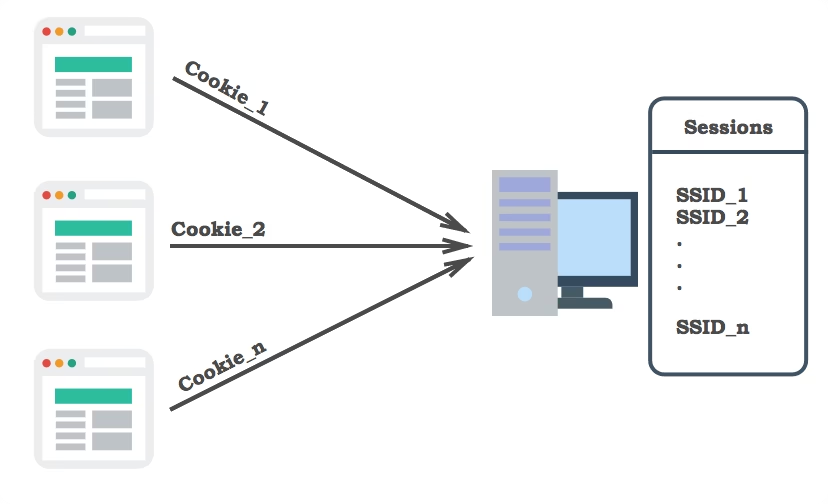
Cookies and Sessions store user data and maintain state across multiple requests in web applications. However, they differ in how they store and manage data. Cookies Cookies are small data stored on the client side (browser) and sent to the server with each request. Key Features of Cookies: Example of Setting a Cookie (Python – … Read full article: Session and Cookies: Understanding the Differences

Beginner’s Guide to VI Shortcuts: Master Text Editing Basics

vi editor

The VI editor is a powerful, efficient, ubiquitous text editor in the Unix/Linux ecosystem. For many developers and system administrators, it is a critical tool for editing configuration files, writing scripts, or coding. While VI may initially seem daunting due to its unique modal interface, its shortcodes make it an extremely productive tool when mastered. … Read full article: Beginner’s Guide to VI Shortcuts: Master Text Editing Basics

Understanding Git stages: A Guide to Workflow Management

Git Life Cycle

One of the fundamental concepts in Git is understanding the different Git stages and areas where changes can exist before they are committed to the repository. These areas serve as checkpoints, helping you control and manage what goes into your version history. In this article, we’ll dive into the primary Git areas and their roles … Read full article: Understanding Git stages: A Guide to Workflow Management

Navigating Git: Insights for Tech Professionals

git

Git is a powerful, distributed version control system widely used in software development. It allows multiple developers to work on a project simultaneously while maintaining a history of all changes made to the codebase. Git offers features like branching, merging, and stashing, which enhance collaboration and flexibility. Understanding Git is crucial for modern software development, … Read full article: Navigating Git: Insights for Tech Professionals