In software engineering and computer science, concurrency and parallelism are two of the most frequently confused concepts. Developers often use them interchangeably, but they describe fundamentally different aspects of system architecture and execution.
Understanding this distinction is key to writing scalable, efficient, and responsive applications.
Table of Contents
Defination
Concurrency where multiple tasks execute within the same time window. Doesn’t matter if they take turns or run together — as long as more than one is “in progress” during that window, it’s concurrent.
Note:
Take turns: interleaving the task/context switching
Run together: Possible only if we have multiple cores(Parallelism)
Parallelism where multiple tasks are actually executing at the same instant. Requires more than one physical worker (core/CPU) to be true.
                Program Execution

                     |
        +------------+------------+
        |                         |
   Sequential               Concurrent
                                   |
                      +------------+------------+
                      |                         |
                Time-sliced               Parallel
             (Single CPU/Core)      (Multiple CPU Cores)
(Asynio/ thread)Going Deeper
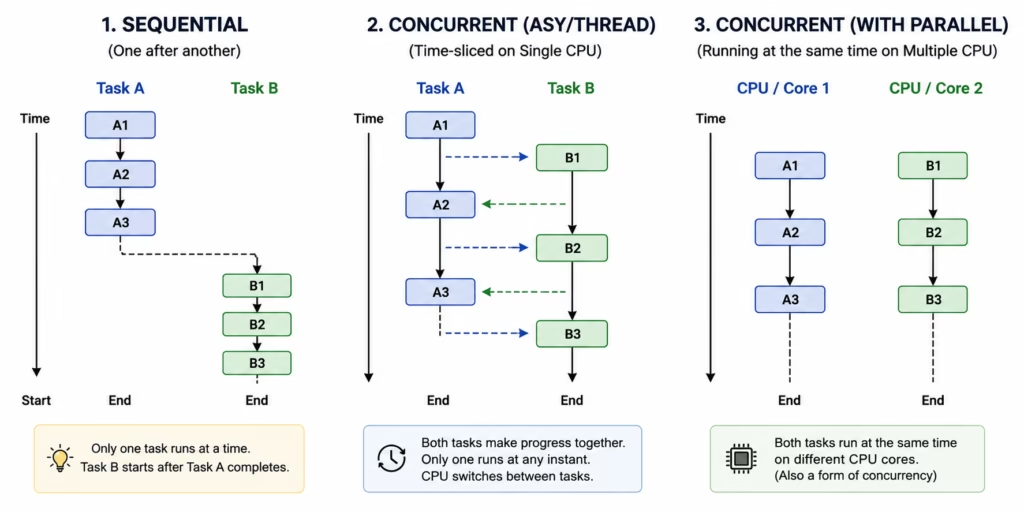
Every parallel system is automatically concurrent because multiple tasks run within the same time window.
But not every concurrent system is parallel because multiple tasks are executing but not at the same instance; the tasks are switching very fast, and it appears that multiple tasks are running, but only one task is running at any instance
       ┌────────────────────────────────────────────────────────┐
       │                  CONCURRENCY                           │
       │                                                        │
       │                                                        │
       │   Single-Core Interleaving      ┌────────────────────┐ │
       │   (Task switching / time-       │    PARALLELISM     │ │
       │    slicing on 1 core)           │ (Multi-core /      │ │
       │                                 │  Simultaneous)     │ │
       │                                 └────────────────────┘ │
└────────────────────────────────────────────────────────┘Three Mechanisms of Concurrent Execution
Depending on your software architecture and hardware environment, concurrency is achieved through three primary models:
Cooperative Multitasking (async / await)
- Mechanism: Interleaving driven by the application code itself.
- How it works: A single thread executes a task until it hits an asynchronous operation (e.g., waiting for network I/O or a disk read). Instead of blocking, the task voluntarily yields control back to an event loop, which picks up another ready task.
- Hardware: Runs on a single CPU core.
- Is it parallel? No. It optimises idle time during I/O operations, but only one piece of code executes at a time.
Preemptive Multitasking (OS Threads)
- Mechanism: Interleaving managed by the Operating System scheduler.
- How it works: The OS allocates tiny time slots (time-slicing) to different threads. When a thread’s time slice expires, the OS forcibly pauses it, saves its state (context switch), and loads another thread.
- Hardware: Runs on a single CPU core (or across multiple cores).
- Is it parallel? No on a single core. It creates the illusion of simultaneous execution through rapid context switching.
Multi-Core Hardware Execution (True Parallelism)
- Mechanism: Physical hardware execution across separate processing units.
- How it works: Concurrent threads or processes are distributed across separate physical cores or CPUs, running instructions at the same physical millisecond.
- Hardware: Requires multi-core processors, multi-CPU systems, or GPUs.
- Is it parallel? Yes. This is physical parallelism.
Comparing the Approaches
| Feature | async / await | Preemptive Threading | Multi-Core Parallelism |
| Primary Unit | Tasks / Coroutines | OS Threads | Processes / Worker Threads |
| Switching Trigger | Voluntary (Yield on I/O) | Involuntary (OS Scheduler) | N/A (Runs simultaneously) |
| Overhead | Very Low (Low memory, no OS context switch) | Moderate (Memory for thread stacks, OS context switching) | Higher (Inter-process communication, hardware synchronisation) |
| Best Used For | I/O-bound tasks (Web servers, API calls) | Mixed workloads, background tasks | CPU-bound tasks (Data processing, image rendering, ML) |
| Physical Parallelism | ❌ No | ❌ No (on 1 core) / Yes (on multi-core) | Yes |
Analogies 1
| Execution Model | Coffee Shop Analogy |
|---|---|
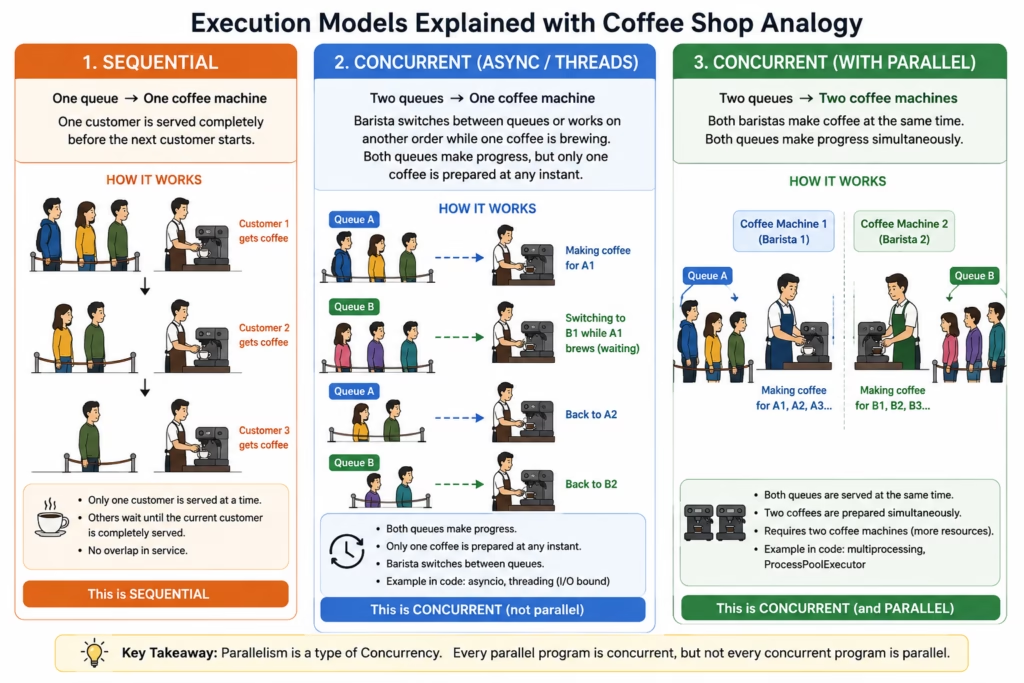
| Sequential | One queue → One coffee machine. One customer is served completely before the next customer starts. |
| Concurrent (Async / Threads) | Two queues → One coffee machine. The barista switches between the two queues (or works on another order while one coffee is brewing). Both queues make progress, but only one coffee is actively being prepared at any instant. |
| Concurrent (Parallel) | Two queues → Two coffee machines (and two baristas). Both coffees are prepared simultaneously. This is true parallel execution, and it’s also concurrent because both queues are making progress together. |
Analogies 1
| Execution Model | Family Analogy |
|---|---|
| Sequential | When my wife is busy taking care of our child, the household chores wait. After she finishes with the child, she starts the household chores. |
| Concurrent (Async / Thread) | When I’m not at home, my wife takes care of our child while also managing household chores. She constantly switches between the two tasks as needed. Both tasks make progress, but she can actively do only one thing at a time. |
| Concurrent (Parallel) | When I’m at home, I take care of our child while my wife handles the household chores. Both tasks happen at the same time because two people are working simultaneously. |
Concurrency and parallelism
Case 1: Concurrent and Parallel
- What it means: The software is designed to manage multiple independent tasks, and the hardware has multiple cores running them at the same physical millisecond.
- Example: A modern 3D video game engine running on an 8-core CPU—where Core 1 calculates physics, Core 2 processes audio, and Core 3 renders graphics simultaneously. Within cores, we are switching the task as well
Case 2: Concurrent but Not Parallel
- What it means: The software is decomposed into independent, overlapping tasks, but they run on a single CPU core. The OS or runtime switches between tasks rapidly (
async/awaitor time-slicing), giving the illusion of simultaneous progress. - Example: A Node.js web server handling thousands of incoming API requests on a single-core virtual machine, or a single-core computer running a browser while playing background music.
Case 3: Parallel but Not Concurrent
- What it means: This case is impossible in practice.
- Why: You cannot physically execute multiple tasks in parallel unless your application is first structured to divide work into independent, overlapping units (concurrency). Parallelism is a subset of concurrency; hardware cannot run things side-by-side if the software architecture is strictly sequential.
Case 4: Neither Concurrent nor Parallel
- What it means: A simple sequential program running on a single CPU core. Tasks must finish before the next task begins, with no overlapping lifecycles or simultaneous execution.
- Example: A simple command-line script that reads a text file line-by-line, converts each line to uppercase, and writes the output to a new file.
Quick Comparison Matrix
| Case | Software Design | Hardware Execution | Possible? |
| Case 1 | Decomposed into overlapping tasks | Multi-core physical execution | Yes |
| Case 2 | Decomposed into overlapping tasks | Single-core context switching/event loop | Yes |
| Case 3 | Strictly sequential | Multi-core physical execution | ❌ Impossible |
| Case 4 | Strictly sequential | Single-core single execution | Yes |
Conclusion
Concurrency provides the blueprint for breaking complex applications into independent, manageable units of work, while parallelism provides the hardware engine to execute those units simultaneously. Ultimately, concurrency is about smart software design, and parallelism is about raw hardware execution. Mastering both allows you to build systems that remain responsive under heavy I/O workloads and scale seamlessly across modern multi-core processors.

1 thought on “Understanding Concurrency vs. Parallelism: The Definitive Guide”