Every system hits a wall eventually. Requests pile up, latency climbs, and the database starts sweating. At that moment, every engineer faces the same fork in the road: do we make the machine bigger, or do we add more machines?
That choice — vertical scaling versus horizontal scaling — is one of the most consequential decisions in system design. Get it right, and your architecture grows gracefully with traffic. Get it wrong, and you’re either paying for hardware you can’t fully use, or you’ve built a distributed system out of an app that was never designed for one. This article breaks down both approaches completely — how they work, where they break, and how production systems combine them.
Table of Contents
The Problem: Your System Is Slowing Down
Traffic doubles. Response times climb. Your system, which used to take 20ms, now takes 400ms. You have two choices: make the machine bigger, or add more machines. That’s scaling in a sentence.
The decision between those two paths has enormous consequences — for cost, reliability, and application architecture. This article breaks down both approaches completely: how they work, where they fail, and how real systems use them together.
What Is Vertical Scaling?
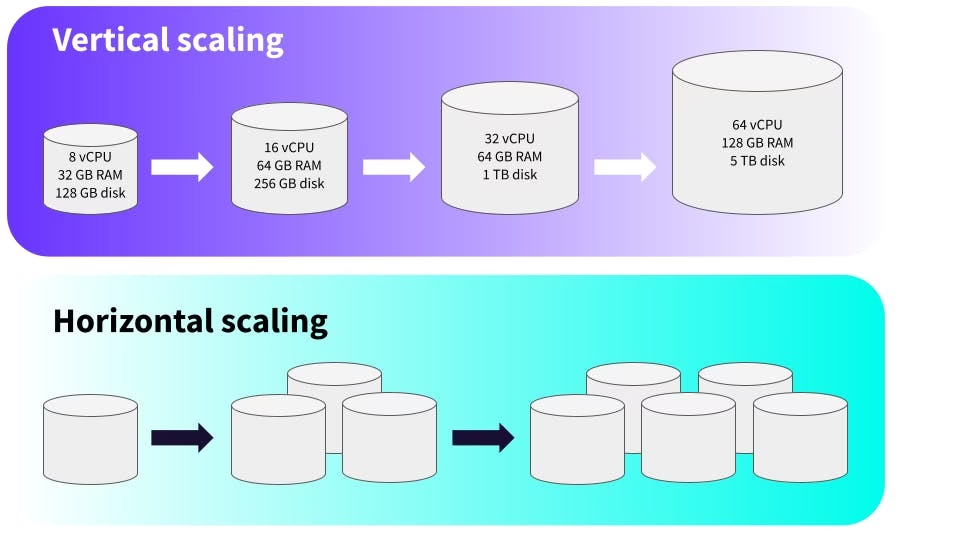
Vertical scaling means upgrading the existing server to a more powerful one. More CPU cores, more RAM, faster NVMe storage, higher-bandwidth network cards. The application doesn’t change — it just wakes up with more resources available.
How It Works
On a cloud provider, this is a resize operation. You stop the instance, change the instance type — say from an m5.xlarge (4 vCPU, 16 GB RAM) to a c6i.16xlarge (64 vCPU, 128 GB RAM) — and restart. The OS and your application see the new capacity automatically. No code changes, no load balancer configuration, no distributed system design. It just works.
On bare metal, you physically swap out hardware: add DIMMs to increase RAM, replace the CPU, upgrade the NIC. More involved, but the same idea.
Where It Shines
Vertical scaling is the right choice for systems where state is hard to distribute. The prime example is a relational database like PostgreSQL or MySQL. A single large Postgres instance can handle an enormous amount of load, and the operational complexity of a single well-tuned machine is dramatically lower than a sharded cluster. Most startups should vertical-scale their database far longer than they think before entertaining horizontal alternatives.
It’s also the right choice for:
- Single-threaded or lock-heavy workloads — adding more machines doesn’t help if the bottleneck is a mutex or a global lock. You need the lock to release faster, which means faster hardware.
- Legacy monolithic applications — apps not designed for distributed operation can’t be horizontally scaled without significant refactoring. Vertical scaling buys time.
- Low-traffic internal tools — the operational overhead of a distributed system is never worth it for a tool used by 50 people.
The Fundamental Limitation: The Hardware Ceiling
Every machine has a top. AWS’s largest general-purpose instance (as of 2024) gives you 448 vCPUs and 24 TB of RAM. Beyond that, you simply cannot scale further. This is not a soft limit you can negotiate around — it is a physical boundary.
Worse, the cost curve is non-linear. Moving from a mid-tier instance to the largest available instance doesn’t cost proportionally more — it costs dramatically more, because top-tier hardware is scarce and premium-priced. You often pay 3–5x per unit of compute at the high end versus the middle of the range.
The Single Point of Failure Problem
A vertically-scaled architecture has one machine serving traffic. When that machine fails — and at some point, it will — your entire system goes down. No redundancy, no graceful degradation. The bigger the machine you’ve scaled to, the more catastrophic the failure.
This is the decisive argument against vertical-only scaling for anything customer-facing that requires high availability.
Vertical Scaling at a Glance
| Property | Characteristic |
|---|---|
| Scaling limit | Hard hardware ceiling |
| Fault tolerance | Single point of failure |
| Application changes required | None |
| Downtime during scaling | Typically, yes (restart) |
| Cost curve | Linear to mid-tier, then spikes sharply |
| Operational complexity | Low |
| Best fit | Databases, stateful legacy apps |
What Is Horizontal Scaling?
Horizontal scaling means adding more machines running the same software and distributing the load across all of them. Instead of one powerful server, you have ten (or a hundred) commodity servers working in parallel.
A load balancer sits in front of the fleet, routing each incoming request to one of the available nodes. When the load increases, you add more nodes. When the load drops, you remove them. In cloud environments, this can happen automatically — auto-scaling groups spin instances up and down based on CPU or request rate metrics.
The Stateless Requirement: The Critical Constraint
Horizontal scaling sounds simple until you think carefully about state. Consider what happens if a user logs in — their session is created on Server 1. Their next request arrives and is routed to Server 2. Server 2 knows nothing about their session. Authentication fails.
This is why horizontal scaling requires a stateless application design. Each server must be capable of handling any request, independent of which server handled previous requests from the same user. This means externalising all state:
- User sessions → Redis or a distributed session store
- Uploaded files → Object storage (S3, GCS)
- Application state → A shared database
- Distributed locks → Redis or ZooKeeper
- Rate-limit counters → Redis with atomic increments
Once state lives outside the servers themselves, the servers become disposable. You can terminate any one of them at any time, and the system keeps running. This is the architecture that enables zero-downtime deploys (rolling restarts), auto-scaling, and true fault tolerance.
The Load Balancer
The load balancer is the entry point to a horizontally scaled fleet. It receives all incoming traffic and distributes it across healthy backend servers. Common algorithms:
Round-robin is the simplest: requests go to Server 1, Server 2, Server 3, then back to Server 1. Works well when requests are roughly equal in cost.
Least connections routes each request to the server currently handling the fewest active connections. Better for workloads where some requests are much more expensive than others — it avoids piling more work onto an already-busy node.
Consistent hashing assigns requests to servers based on a hash of a key (typically a user ID or session ID). The same key always routes to the same server. This is critical for cache affinity — if you want a particular user’s data to consistently land on the same cache node, you use consistent hashing. It also minimises cache invalidation when nodes are added or removed. Read more
The load balancer also performs health checking — periodically probing each backend server. If a probe fails, that server is removed from rotation and traffic stops flowing to it. When it recovers (or is replaced), it rejoins the pool. This is the mechanism that gives horizontal architectures their fault tolerance.
The Shared State Layer
Every horizontally scaled system needs a fast, consistent shared store for things multiple nodes need to agree on. Redis is the default answer. Its data structures map naturally to common distributed state problems:
- Strings with TTL → session storage
- Atomic increment → distributed counters, rate limiting
- Pub/sub → real-time notifications, cache invalidation broadcasts
- Sets/sorted sets → leaderboards, ranked feeds
- Distributed locks (Redlock) → ensuring only one node performs a job at a time
The shared state layer is often the first bottleneck in a horizontal architecture. If every request must hit Redis, Redis can become the single point of contention. Solutions include client-side caching, read replicas, and careful TTL management.
Distributed System Challenges
Horizontal scaling is not free. Adding more machines introduces a class of problems that don’t exist on a single server:
Partial failures. On a single server, a failure means the whole system is down. In a distributed system, one node can fail while others are healthy. Your application must handle this gracefully — detect dead nodes, retry requests, degrade functionality rather than failing.
Consistency. If two nodes write to the same record simultaneously, which write wins? Distributed systems require careful reasoning about ordering, locking, and eventual consistency. This is the CAP theorem in practice.
Network latency. Every call between services incurs ~1ms of network overhead that doesn’t exist in a single-process system. A request that triggers 20 downstream service calls adds 20ms of unavoidable latency. This is why thoughtful service decomposition matters — chatty interfaces kill performance in distributed systems.
Operational overhead. A fleet of 50 servers requires infrastructure tooling: container orchestration (Kubernetes), service discovery, distributed tracing, centralised logging, and deployment pipelines. This is legitimate work. Small teams should not underestimate it.
Horizontal Scaling at a Glance
| Property | Characteristic |
|---|---|
| Scaling limit | Theoretically infinite |
| Fault tolerance | High — redundant nodes, no SPOF |
| Application changes required | Stateless design, external state |
| Downtime during scaling | None (rolling deploys) |
| Cost curve | Linear with node count |
| Operational complexity | High |
| Best fit | Stateless API servers, workers, and NoSQL |
Head-to-Head Comparison
| Dimension | Vertical | Horizontal |
|---|---|---|
| Speed to implement | Fast — resize and restart | Slow — requires architecture changes |
| Fault tolerance | Poor — single point of failure | Excellent — any node can fail |
| Scale ceiling | Hard hardware limit | No practical limit |
| Application design | Simple | Must be stateless |
| Downtime during growth | Yes (restart) | No (add nodes) |
| Network complexity | None | Load balancer, service mesh |
| Cost efficiency | Good at mid-tier, poor at top | Consistent at any scale |
| Auto-scaling | No | Yes |
The Decision Rule
A practical heuristic: start vertical, switch to horizontal when you cross 70–80% of machine capacity or when availability requirements demand redundancy.
For a new product, vertical scaling gets you to meaningful scale quickly with minimal operational complexity. As load grows, you migrate the stateless layers to horizontal scaling first (easiest, highest leverage). The database stays vertical until the query volume or data size genuinely demands sharding, which, for most applications, is much later than engineers expect.
Common Misconceptions
Horizontal scaling is always better. Not true. For a relational database serving a moderate load, a well-tuned single large instance outperforms a poorly-designed sharded cluster in both latency and operability. Horizontal scaling adds complexity that actual requirements must justify.
Vertical scaling doesn’t scale. It scales up to a hard ceiling that is higher than most workloads ever reach. The top-tier AWS instance has more compute than most companies will ever need for a single service.
Horizontal scaling is cheaper. It can be, but not always. A single large instance often has better price/performance than the equivalent capacity in small instances, especially when you factor in the operational overhead of running a distributed system.
My app is automatically horizontally scalable. Only if it’s stateless. Many applications make implicit assumptions about local state — in-process caches, local file writes, in-memory session stores — that silently break when load-balanced across multiple instances.
Summary
Vertical and horizontal scaling are complementary tools, not competing ones.
Vertical scaling is fast, simple, and powerful – but bounded by hardware limits and vulnerable to single points of failure. It is the right starting point for most workloads, and the right long-term home for stateful systems like relational databases.
Horizontal scaling is resilient, infinitely extensible, and cloud-native — but it requires stateless application design, a shared state layer, and the operational investment to run a distributed system. It is the right architecture for any layer that requires high availability or must scale beyond a single machine’s capacity.
The most important skill is knowing which to apply where — and having the discipline to start simple and add complexity only when the system demands it.

1 thought on “Vertical vs Horizontal Scaling: A Complete Guide for System Designers”