Dynamic Programming (DP) is an optimisation technique that solves complex problems by breaking them down into smaller, overlapping subproblems and storing their results to avoid redundant calculations.
Table of Contents
About DP
- Solver smaller sub-problems
- Stored the results of smaller problems
- Reuse the stored result to solve the actual problem
Why do we even need dynamic programming?
Before DP, let’s understand the problem DP is solving. While solving a problem, we often end up solving the same smaller problems again and again. This causes exponential time and wasted effort.
This leads to:
- Huge time complexity (exponential)
- Slow or impossible solutions for large inputs
Example: Fibonacci
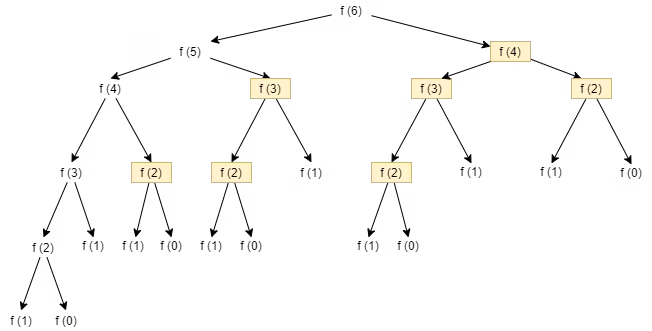
To compute for fib(6) , fib(4), fib(3), fib(2) and fib(1) are computed multiple times
| Fibonacci call | Times computed |
|---|---|
fib(4) | 2 times |
fib(3) | 3 times |
fib(2) | 5 times |
fib(1) | 3 times |
Time complexity becomes O(2ⁿ)
DP fixes this by:
- Solving each subproblem once
- Storing the result
- Reusing it whenever needed
What Is Dynamic Programming?
Dynamic Programming is an optimisation technique where we store the results of subproblems to avoid recomputation.
Formally:
DP is a technique to solve problems with overlapping subproblems and optimal substructure by storing intermediate results.
DP is not a new algorithm — it’s recursion + memory
Enhanced Recursion
Dynamic Programming is optimised recursion where overlapping subproblems are solved once and reused.
What recursion alone does
- Explores all choices
- Repeats the same subproblems again and again
- Thinks in a top-down way
Example
fib(5)
 ├─ fib(4)
 │   ├─ fib(3)
 │   │   ├─ fib(2)
 │   │   └─ fib(1)
 │   └─ fib(2)
 └─ fib(3)
     ├─ fib(2)
└─ fib(1)Same calls → wasted work
What DP enhances in recursion
DP does three upgrades:
- Memoisation (memory): If I’ve solved it once, don’t solve it again.
- Store the result of (state)
- Reuse it next time
DP is a technique that converts an exponential recursive solution into an efficient one by caching results of overlapping subproblems and solving them in a structured order.
Exponential → PolynomialThe Two Fundamental Properties of DP
Overlapping Subproblems
The same subproblem appears multiple times.
Example
- Fibonacci
- Climbing stairs
- Coin change
- Knapsack
If there is no repetition, DP is useless.
Optimal Substructure
An optimal solution of the problem can be built from optimal solutions of subproblems.
i.e My best answer depends on the best answers of smaller versions of the same problem.
Example
- Shortest path
- Maximum profit
- Minimum coins
If an optimal substructure does not exist, DP fails.
Two Ways to Do Dynamic Programming
Top-Down DP (Memoisation)
- Start from the main problem
- Go downward (recursion)
- Store results
Bottom-Up DP (Tabulation)
- Start from the smallest subproblem
- Build upwards
- No recursion
- Iterative approach
We say DP is about recursion, but in the bottom-up approach, there are no recursive calls. Why is it still called DP?
- Bottom-Up DP removes recursion from the code, not from the logic.
- DP is not about recursion in code — it’s about recursion in logic.
- Every Bottom-Up DP has a hidden recursion. Take an example
fib(n) = fib(n-1) + fib(n-2)


dp[0] = 0
dp[1] = 1
for i in range(2, n+1):
    dp[i] = dp[i-1] + dp[i-2]
- Think of Bottom-Up as recursion flattened
fib(0) → fib(1) → fib(2) → fib(3) → fib(4) → fib(5)- Bottom-Up DP is just Top-Down DP, except that the call stack is replaced with loops.
How to guess it’s a DP problem?
Step 1: Can the problem be broken into smaller, similar subproblems?
If you can say: To solve for n, I need answers for n-1, n-2, …
Examples:
- Fibonacci
- Climbing stairs
- Knapsack
- LIS, LCS
👉 This is an optimal substructure.
Step 2: Are you asked to find min/max/count / best way?
Examples:
- maximum profit
- minimum cost
- number of ways
- longest / shortest
👉 DP loves optimisation & counting
3. You have choices at every step that affect future results?
Keywords:
- choose/pick/skip
- take / not take
- buy/sell / cooldown
- include/exclude
👉 Choices = branching → DP.
Final intuition
Don’t guess, DP. You eliminate everything else:
- Too big for brute force ❌
- Greedy fails ❌
- Same subproblem repeats ✅ → DP
One-line DP Detector
If the problem asks for an optimal answer over choices, and the same subproblem can appear again → DP
How to Think in DP?
After identification of the problem as dp problem. Ask these exact questions.
Step 1: What is the state?
What information uniquely defines a subproblem?
- Each independent variable that changes in recursion becomes a DP state dimension.
- A DP state is defined by the minimum set of changing variables needed to uniquely identify a subproblem.
- Based on different variables:
- Number of states =1, we call it 1d dp
- Number of states =2. We call it 2d dp
Example:
- Fibonacci → n
- Knapsack → (index, capacity)
- LCS → (i, j)
Step 2: What is the transition?
- How does the current state depend on smaller states?
- If I am in this state, what are my options, and where do they take me?
Template
dp[state] = best(
    dp[next_state_1],
    dp[next_state_2],
    ...
)Example: Fibonacci
Transition moves:
- n → n-1
- n → n-2
dp[n] = nth Fibonacci number

dp[n] = dp[n-1] + dp[n-2]Example House Robber (1D DP)
Choices at the house i
- Skip house i
- Rob house i
dp[i] = max money from houses [0..i]

dp[i] = max(
    dp[i-1],                 # skip
    dp[i-2] + nums[i]        # rob
)Example Coin Change (Unbounded Knapsack)
Choices
- Skip coin i
- Use coin i again
dp[i][amount] = number of ways using coins[0..i]


dp[i][amount] =
    dp[i-1][amount]           # skip
+ dp[i][amount - coin[i]] # take againStep 3: What are the base cases/stopping criteria?
Smallest valid inputs.
dp[0] = 0
dp[1] = 1Step 4: What is the final answer?
Which DP state do we return?
The Practical Rule
While learning DP, always follow:
Recursion
   ↓
Memoization (Top-Down DP)
   ↓
Tabulation (Bottom-Up DP)
   ↓
Space Optimization (if possible)- This order matches how your brain understands the problem → how the computer optimises it.
- Top-down matches the natural flow of the problem.
Why 4 approaches to the same problem
| Step | What YOU learn | What COMPUTER gains |
|---|---|---|
| Recursion | Problem structure | Nothing |
| Memoization | Overlapping states | Speed |
| Tabulation | Execution order | Stack-free DP |
| Space Opt | State dependency | Memory efficiency |
- Recursion teaches thinking.
- Memoisation proves DP.
- Tabulation engineers it.
- Space optimisation polishes it.
Tabulation looks easier?
This is valid confusion. Let’s dip dive
- Tabulation is easier to EXECUTE
- Recursion is easier to THINK
- If you already understand the problem → Tabulation is fine
- If the problem is new/tricky/unfamiliar → Start with Recursion
Common Dp pattern
0/1 Knapsack(6 Variation)
Core idea: take or skip (once)
- Subset Sum
- Equal Sum Partition
- Count of Subsets with Given Sum
- Minimum Subset Sum Difference
- Target Sum
- No. of subsets of given difference
Pattern: dp[i][w] → decision-based DP
Unbounded Knapsack — 4 Variations
Core idea: can take an item an unlimited number of times
- Coin Change – Min Coins
- Coin Change – Number of Ways
- Rod Cutting
- Integer Break
Pattern: dp[w] or dp[i][w] with same index reuse
Fibonacci Family — 7 Variations
Core idea: dp[i] depends on the last few states
- Fibonacci Number
- Climbing Stairs
- Min Cost Climbing Stairs
- House Robber
- House Robber II
- Decode Ways
- Tribonacci
Pattern: dp[i] = f(dp[i-1], dp[i-2])
LCS Family — 15 Variations
Core idea: two strings, match or skip
- Longest Common Subsequence
- Longest Common Substring
- Shortest Common Supersequence
- Edit Distance
- Delete Operation for Two Strings
- Insert/Delete to Convert String
- Longest Palindromic Subsequence
- Min Deletions to Make Palindrome
- Distinct Subsequences
- Count Palindromic Subsequences
- Wildcard Matching
- Regex Matching
- Sequence Pattern Matching
- Minimum Insertions to Make a Palindrome
- Print LCS
Pattern: dp[i][j] (string DP backbone)
LIS Family — 10 Variations
Core idea: increasing order + history
- Longest Increasing Subsequence
- Maximum Sum Increasing Subsequence
- Longest Decreasing Subsequence
- Longest Bitonic Subsequence
- Number of LIS
- Russian Doll Envelopes
- Longest Chain of Pairs
- Box Stacking
- Increasing Triplet
- LIS with Difference Constraint
Pattern: dp[i] = best ending at i
Kadane’s Algorithm — 6 Variations
Core idea: local vs global optimum
- Maximum Subarray Sum
- Maximum Circular Subarray
- Maximum Product Subarray
- Longest Subarray with Positive Product
- Maximum Sum Rectangle (2D Kadane)
- Stock Buy & Sell (Single Transaction)
Pattern: reset vs extend
Matrix Chain Multiplication — 7 Variations
Core idea: partition DP
- Matrix Chain Multiplication
- Palindrome Partitioning
- Boolean Parenthesization
- Burst Balloons
- Scramble String
- Egg Dropping
- Min Cost to Cut Stick
Pattern: dp[i][j] = min/max over k
DP on Trees — 4 Variations
Core idea: post-order DP
- Diameter of Tree
- Maximum Path Sum
- House Robber III
- Binary Tree Cameras
Pattern: return multiple values from child
DP on Grid — 14 Variations
Core idea: paths + directions
- Unique Paths
- Unique Paths II
- Minimum Path Sum
- Maximum Path Sum
- Dungeon Game
- Cherry Pickup I
- Cherry Pickup II
- Triangle
- Falling Path Sum
- Falling Path Sum II
- Gold Mine
- Maximal Square
- Count Square Submatrices
- Largest Rectangle in Matrix
Pattern: dp[i][j] from neighbors
Others — 5 Variations
Mixed but important
- Partition Array for Max Sum
- Word Break
- Perfect Squares
- Catalan Numbers
- Dice Roll Ways
Lets Warm-up
Knapsack Family
Example 1: Fibonacci
Example f(6) = f(5) + f(4) so,
f(n) = f(n-1) + f(n-2)
State: we have a dependency on only one variable, n, and it is a 1-D
Transition: we have to travel from n-1 and n-2 to reach n
Base Cases / Stopping Criteria
- dp[0] = 0
- dp[1] = 1
Resursion
def fib(n):
    if n <= 1:
        return n
return fib(n-1) + fib(n-2)Problem ❌
- Same subproblems repeated
- fib(5) recomputes fib(3) multiple times
- Time: O(2^n)
- This is a decision tree explosion
👉 Recursion gives correct logic, but wastes work
Memoisation (Top-Down DP)
def fib(n, dp):
    if n <= 1:
        return n
    if dp[n] != -1:
        return dp[n]

    dp[n] = fib(n-1, dp) + fib(n-2, dp)
    return dp[n]


#Example
n = 10
dp = [-1] * (n+1)
print(fib(n, dp))
Tabulation (Bottom-Up DP)
def fib(n):
    if n <= 1:
        return n

    dp = [0] * (n+1)
    dp[1] = 1

    for i in range(2, n+1):
        dp[i] = dp[i-1] + dp[i-2]

return dp[n]Space Optimization
- To compute dp[i], we only need dp[i-1] and dp[i-2]
- ❌ We don’t need the full array.
- Replace the DP table with variables
def fib(n):
    if n <= 1:
        return n

    prev2 = 0   # fib(0)
    prev1 = 1   # fib(1)

    for i in range(2, n+1):
        curr = prev1 + prev2
        prev2 = prev1
        prev1 = curr

return prev1Example 2 Climbing Stairs
Recursion
def climb(n):
    if n <= 1:
        return 1
return climb(n-1) + climb(n-2) Memoization
def climb(n, memo={}):
    if n <= 1:
        return 1
    if n in memo:
        return memo[n]

    memo[n] = climb(n-1, memo) + climb(n-2, memo)
    return memo[n]
Tabulation
def climb(n):
    dp = [0]*(n+1)
    dp[0] = dp[1] = 1

    for i in range(2, n+1):
        dp[i] = dp[i-1] + dp[i-2]

return dp[n]Space Optimization
def climb(n):
    a, b = 1, 1
    for _ in range(2, n+1):
        a, b = b, a+b
    return b
Example 3 House Robber
Recursion
def rob(i, nums):
    if i >= len(nums):
        return 0

    take = nums[i] + rob(i+2, nums)
    skip = rob(i+1, nums)

    return max(take, skip)
Memoization
def rob(i, nums, memo={}):
    if i >= len(nums):
        return 0
    if i in memo:
        return memo[i]

    memo[i] = max(
        nums[i] + rob(i+2, nums, memo),
        rob(i+1, nums, memo)
    )
return memo[i]Tabulation
def rob(nums):
    n = len(nums)
    dp = [0]*(n+2)

    for i in range(n-1, -1, -1):
        dp[i] = max(nums[i] + dp[i+2], dp[i+1])

    return dp[0]


  def rob():
    length = len(nums)
    if length==1:
        return nums[0]

    dp = [0]*length
    dp[0] = nums[0]
    dp[1] = max(nums[0],nums[1])

    for i in range(2,length):
        dp[i] = max(dp[i-2]+nums[i],dp[i-1])

return dp[length-1]Space Optimization
find out the code for this Why does the house robber problem feel different from the Fibonacci or the climbing Stairs problem?
- Fibonacci & Climbing Stairs
- : No decision, No Choice
- You must take both paths
- You are counting all possibilities
- House Robber = a decision problem
- You can skip
- Or you can take
- But you cannot take both
So, House Robber is of Knapsack-type DP, while Fibonacci and Climbing are not Knapsack-type.
LCS
Problem to practice
https://www.geeksforgeeks.org/competitive-programming/dynamic-programming
See and remove
Put all 100 list question maps
https://docs.google.com/document/d/1Xn6jyVEuxg_ZqoTSGwvRoYa4g4v6BQbwd1JcAX403Sg/edit?tab=t.0
https://chatgpt.com/g/g-p-696d0a98c504819189a251a99c68858a-dp/c/698ad4c1-1d88-8320-b807-0a4fe142fab8
DP
├── Counting
├── Knapsack / Decision
├── State Machine
├── Interval
└── Tree / Graph


Bitset Knapsack
dp on broken profile
Digit Dp